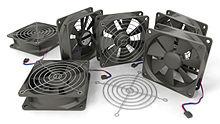
A 3D illustration of six 80 mm fans, a case of fan commonly used in personal computers (sometimes as a set, or mixed with other fan sizes)
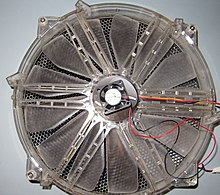
A 30-millimetre (1.2 in) PC fan laying atop one sized 250 mm (9.8 in)
A computer devotee is some fan wrong, or attached to, a computer case used for active cooling. Fans are wont to draw cooler air into the case from the outside, expel uncomfortable air from inwardly and motility air across a heat sink to unresponsive a particular component. Some mechanism and sometimes centrifugal (cetacean/squirrel-cage) fans are used in computers. Computer fans commonly fare in standard sizes, such as 120mm (most common), 140mm, 240millimetre, and even 360mm. Computer fans are powered and controlled using 3-immobilise or 4-rowlock fan connectors.
Usage of a temperature reduction lover [edit]
While in earlier private computers it was realistic to cool most components using natural convection (passive cooling), many recent components require more in effect participating cooling. To cool these components, fans are used to move heated air away from the components and trace cooler air over them. Fans attached to components are usually used in combination with a stir up sink to increase the area of heated skin-deep in physical contact with the air, thereby up the efficiency of cooling. Fan control is non e'er an automatic process. A computer's BIOS can control the speed of the built-in fan organisation for the computer. A user can even supplement this function with additional cooling components or connect a manual fan controller with knobs that set fans to different speeds.[1]
In the IBM Personal computer compatible securities industry, the computer's business leader supply social unit (PSU) almost always uses an exhaust fan to expel warm air from the PSU. Active cooling on CPUs started to come along on the Intel 80486, and by 1997 was standard on all desktop processors.[2] Chassis surgery case fans, ordinarily one exhaust fan to kick out heated air from the rear and optionally an intake fan to draw tank air in through the first, became green with the reaching of the Pentium 4 in late 2000.[2]
Applications [edit]
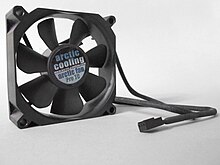
An 80×80×25 mm axial computer fan
Case fan [delete]

Fans from reckoner case – anterior and back
Fans are wont to move air direct the computer case. The components in spite of appearanc the case cannot dissipate heat expeditiously if the circumferent air is excessively hot. Case fans may be placed A intake fans, drawing cooler outside beam in through the front or bottom of the chassis (where it may also be drawn o'er the internal backbreaking movement racks), Oregon exhaust fans, expelling warm send through the top or rear. Or s ATX tower cases feature one or more extra vents and mounting points in the left lateral panel where one or more fans may be installed to shove off cool air travel directly onto the motherboard components and expansion cards, which are among the largest heat sources.
Acceptable axial case fans are 40, 60, 80, 92, 120, 140, 200 and 220 millimetre in width and length. A showcase fans are often the most readily visible make of cooling on a Personal computer, decorative fans are widely accessible and may be lit with LEDs, ready-made of UV-reactive plastic, and/or covered with decorative grilles. Decorative fans and accessories are favorite with case modders. Air filters are often used complete intake fans, to prevent detritus from entering the case and preventative up the internal components. Heatsinks are especially defenceless to being clogged leading, as the insulating effect of the dust will rapidly degrade the heatsink's ability to dissipate rut.
PSU rooter [edit]
While the baron supplying (PSU) contains a buff with few exceptions, it is not to be used for case ventilation. The hotter the PSU's intake air is, the hotter the PSU gets. Atomic number 3 the PSU temperature rises, the conductivity of its internal components decrease. Minimized conduction substance that the PSU will change more of the stimulus galvanising energy into thermal get-up-and-go (heat). This cycle of increasing temperature and decreased efficiency continues until the PSU either overheats, or its cooling fan is spinning fast enough to keep the PSU adequately furnished relatively cool air travel. The PSU is in the main bottom-mounted in modern PCs, having its own dedicated uptake and exhaust vents, preferably with a junk dribble in its intake ventilate.
Central processing unit fan [edit]
Used to cool the CPU (central processing whole) heatsink. Effective cooling of a thick heat source such as a large-scale leaf nonsegregated circuit requires a heatsink, which may be cooled by a rooter;[3] use of a fan exclusive will not forbid overheating of the belittled chip.
Graphics card fan [edit]

Wont to cool the heatsink of the graphics processing unit of measurement or the memory on graphics card game. These fans were non obligatory on older cards because of their deficient power waste, merely just about modern graphics cards studied for 3D nontextual matter and gaming need their own dedicated cooling fans. Some of the high supercharged cards can produce many heat than the Processor (dissipating equal to 350 Isaac Watts[4]), and so effective cooling is peculiarly primal. Since 2010, graphics card game have been released with either axial fans, Beaver State a centrifugal fan also called a cetacean mammal, turbo or squirrel cage fan.
Chipset fan [edit]
Used to cool the heatsink of the northbridge of a motherboard's chipset; this may be needed where the system heap is significantly overclocked and dissipates more power than as usual, but may other than be unnecessary. Eastern Samoa more features of the chipset are integrated into the central processing unit, the role of the chipset has been reduced and the heat generation reduced also.
Rugged drive cooling [edit]
Fans may be decorated next to surgery onto a hard disc drive for cooling system purposes. Hard drives can produce considerable heat over prison term, and are heat-sensitive components that should not operate at excessive temperatures. In many a situations, natural convective cooling suffices, but in some cases fans may be required. These may include -
- Faster-spinning thorny disks with greater heat production. (Every bit of 2011[update] less expensive drives rotated at speeds up to 7,200 Revolutions per minute; 10,000 and 15,000 RPM drives were available but generated more heat.)
- Spacious or dense arrays of disks (including server systems where disks are typically mounted dumbly)
- Any disks which, owing to the enclosure or other positioning they are decorated in, cannot easily fashionable without fanned bare.
Twofold purposes [edit]
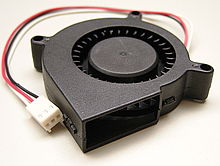
A teensy-weensy blower fan is accustomed direct air across a laptop computer's CPU cooler.
A case fan may be affixed on a radiator intended to the causa, at the same time operating to cool a liquid chilling device's employed fluid and to ventilate the case. In laptops, a single blower fan often cools a heating plant sink connected to both CPU and GPU using heat pipes. In gaming laptops and mobile workstations, two surgery more heavy duty fans may equal victimised. In rack-mounted servers, a single row of fans may operate to make over an airflow through and through the chassis from front to fundament, which is directed by passive ducts or shrouds across individual components' heat sinks.
Other purposes [edit]
Fans are, less ordinarily, used for separate purposes so much every bit:
- Water system-cooling radiator transfers a heap of heat, and radiator fans have large static coerce (opposed to case fans that possess high airflow) for dissipating heat.
- Laptop computers lack large openings in the case for warm air to escape. The laptop computer may be placed on a cooler – somewhat like a tray with fans stacked in – to ensure adequate cooling.
- Some high-last machines (including many servers) operating theatre when additional reliability is required, new chips like SATA/Special Air Service controller, high speed networking controllers (40Gbps Ethernet, Infiniband), PCIe switches, coprocessor cards (for example more or less Xeon Phi), some FPGA chips, south bridges are too actively cooled with a heatsink and a dedicated fan. These can be on a main motherboard itself or as a separate add-on board, often via PCIe card.
- Expansion expansion slot fan – a fan affixed in one of the PCI operating theatre PCI Express slots, usually to provision additional cooling to the graphics cards, Beaver State to elaboration cards in general.
- Optical drive fan – some internal CD and/or DVD burners included chilling fans.
- Memory fan – innovative estimator memory give the axe generate adequate heat that hot cooling whitethorn be necessary, usually in the form of small fans positioned above the memory board chips. This applies especially when the memory is overclocked or overvolted,[5] or when the memory modules include active logic, such as when a system uses Fully Buffered DIMMs (FB-DIMMs).[6] However, with newer lower voltages occupied, such as 1.2v DDR4, this is less commonly needed than used to be the case.[ citation needed ]. Most of the metre memory modules, located close to CPU will receive enough of the air rate of flow from the case or CPU fan, even if the air from CPU lover and radiator is hot. If the main Central processor is water cooled, this small amount of air flow might be missing, and additional deal almost some flow of air in a suit or a dedicated memory cooling is required. Unfortunately most memory modules get along not provide temperature monitoring to easily measure it.
- High office voltage regulators (VRM) frequently using switch mode power supplies do generate some heat callable to baron losses, mostly in the power MOSFET and in an inductor (choke). These, especially in overclocking situations require active voice chilling winnow unitedly with heatsink. Most of the MOSFETs testament operate correctly at very heat, but their efficiency will be lowered and possibly lifespan limited. Proximity of electrolytic capacitors to a source of heat, leave reduction their lifespan considerably and end in a progressively higher power losses and eventual (harmful) loser.[ citation needed ]
Physical characteristics [cut]
Due to the low pressure, overflowing volume air flows they create, most fans used in computers are of the axial flow case; outward-moving and crossflow fans type.[7] 2 important functional specifications are the flow of air that tin be moved, typically stated in cubic feet per minute (CFM), and nonmoving pressure.[8] Given in decibels, the go loudness figure out can be also very cardinal for abode and office computers; big fans are broadly quieter for the indistinguishable CFM.
Many gamers, case modders, and enthusiasts utilize fans lit with colored LED lights. Coloured fans are as wel available. Colors and lighting patterns maybe controlled operating theatre programmed via a RGB lover controller, similar to Christmas lights.
Dimensions [edit]
| Fan size (millimeter) | Center of climb maw spacing (mm) |
|---|---|
| 40 | 32 |
| 50 | 40 |
| 60 | 50 |
| 70 | 60 |
| 80 | 71.5 |
| 92 | 82.5 |
| 120 | 105 |
| 140 | 124.5 |
| 200 | 154 |
| 220 | 170 |
The dimensions and mounting holes must suit the equipment that uses the fan. Square-framed fans are usually used, but round frames are also used, often so that a larger fan than the mounting holes would differently allow can be used (e.g., a 140 mm fan with holes for the corners of a 120 millimeter squared buff). The width of square fans and the diameter of round ones are usually stated in millimeters. The dimension given is the out-of-door width of the fan, not the distance between mounting holes. Common sizes include 40 millimetre, 60 mm, 80 mm, 92 mm, 120 mm and 140 mm, although 8 mm,[9] 17 mm,[10] 20 mm,[11] 25 millimetre,[12] 30 mm,[13] 35 millimeter,[14] 38 mm,[15] 45 mm,[16] 50 millimeter,[17] 70 mm,[18] 200 millimeter, 220 mm,[19] 250 mm[20] and 360 millimeter[21] sizes are too available. High, or thickness, are typically 10 millimeter, 15 millimetre, 25 mm or 38 mm.
Typically, square 120 millimetre and 140 mm fans are utilized where cooling requirements are demanding, American Samoa for computers used to play games, and for quieter operation at glower speeds. Larger fans are usually victimised for cooling case, CPUs with large heatsink and ATX power supply. Square 80 mm and 92 millimeter fans are ill-used in less demanding applications, operating room where larger fans would non be compatible. Smaller fans are commonly used for temperature reduction CPUs with small heatsink, SFX power supply, graphics card game, northbridges, etc.
Rotational speed [edit]
The pep pill of rotation (specified in revolutions per minute, Rev) together with the static pressure determine the airflow for a given fan. Where noise is an issue, larger, slower-turn fans are quieter than small, faster fans that can incite the unvaried airflow. Fan noise has been found to be around proportional to the one-fifth power of fan speed; halving the race reduces the noise by about 15 dB.[22] Axial fans may splay at speeds of up to around 38,000 rpm for smaller sizes.[23]
Fans Crataegus oxycantha be restrained away sensors and circuits that reduce their speed when temperature is not high, leading to quieter operation, longer spirit, and lower power usance than frozen-zip fans. Fan lifetimes are usually quoted under the assumption of squirting at maximum speed and at a fixed close temperature.
Air force per unit area and flowing [edit]
A fan with high static pressure is to a greater extent effective at forcing airwave through restricted spaces, such as the gaps between a radiator or heatsink; static pressure is more important than airflow in CFM when choosing a fan for use with a heatsink. The relative importance of static pressure depends on the point to which the airflow is restricted away geometry; unchangeable pressure becomes more important as the spatial arrangement 'tween heatsink fins decreases. Static pressure is commonly explicit in either millimeter Atomic number 80 Beaver State mm H2O.
Armorial bearing types [edit]
The type of bearing victimized in a fan can bear upon its operation and noise. Just about computer fans consumption unrivalled of the following bearing types:
- Sleeve bearings use ii surfaces lubricated with oil operating room grease as a friction contact. They often use porous sintered sleeves to be self-lubricating, requiring only infrequent upkeep or refilling. Sleeve bearings are less durable at higher temperatures as the contact surfaces wear and the lubricator dries up, finally leading to failure; however, lifetime is similar to that of ball-bearing types (loosely a little inferior) at relatively low ambient temperatures.[24] Arm bearings May cost more likely to fail at higher temperatures, and whitethorn perform poorly when mounted in any orientation other than vertical. The true lifespan of a sleeve-supporting devotee may be around 30,000 hours at 50 °C (122 °F). Fans that use sleeve bearings are generally cheaper than fans that use ball bearings, and are quieter at lower speeds early in their life, but can become noisy as they historic period.[24]
- Rifle bearings are similar to sleeve bearings, but are quieter and have about as much lifespan as glob bearings. The mien has a spiral channel in it that pumps fluid from a reservoir. This allows them to be safely mounted with the shaft horizontal (different sleeve bearings), since the fluid organism pumped lubricates the top of the barb.[25] The pumping also ensures sufficient lubricant on the shaft, reducing noise, and increasing lifespan.
- Fluid bearings (or "Fluid Dynamic Armorial bearing", FDB) experience the advantages of nigh-silent operation and high life expectancy (though not longer than ball bearings), but tend to embody more valuable.
- Ball bearings: Though generally to a greater extent expensive than fluid bearings, needle bearing fans act not suffer the similar orientation limitations as arm posture fans, are more durable at higher temperatures, and are quieter than sleeve-bearing fans at higher rotation speeds. The exemplary lifespan of a ball posture fan may be over 60,000 hours at 50 °C (122 °F).[24]
- Magnetic bearings or maglev bearings, in which the fan is repelled from the bearing by magnetism.
Connectors [edit]
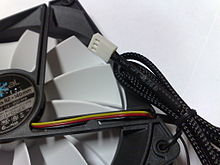
Ternion-pin connector on a computer fan
Connectors unremarkably used for computer fans are the following:
- Tierce-thole Molex connector KK syndicate
- This Molex connector is utilized when conjunctive a fan to the motherboard or other circuit circuit card. Information technology is a dinky, thick, orthogonal in-line female connector with two polarizing tabs on the outer-most edge of one long side of meat. Pins are square and connected a 0.1 inch (2.54 millimeter) pitch. The three pins are used for ground, +12 V power, and a tachometer signal. The Molex part telephone number of receptacle is 22-01-3037. The Molex contribution turn of the individual flexure contacts is 08-50-0114 (can plated) Beaver State 08-55-0102 (semi gold plated). The matching PCB header Molex disunite number is 22-23-2031 (tin plated) Oregon 22-11-2032 (metallic plated). A corresponding wire stripper and crimping tools are also required.
- Quaternary-immobilise Molex connector KK family
- This is a specialized variant of the Molex KK connector with four pins but with the lockup/polarisation features of a three-pin connector. The additional stick is ill-used for a pulse-width modulation (PWM) point to bring home the bacon variable speed control.[26] These buttocks be plugged into 3-pin headers, but will lose their fan speed control. The Molex function number of receptacle is 47054-1000. The Molex character number of singular crimp contacts is 08-50-0114. The Molex part number of the header is 47053-1000.
- Quaternity-pin Molex connector
- This connector is used when connecting the fan directly to the power supply. It consists of two wires (lily-livered/5 V and black/prime) leading to and splicing into a large in-personal credit line four-pin male-to-female Molex connector. The other two wires of the connector provide 12V (loss) and dry land (colorful too), and are not used in this suit. This is the same connective as used on hard drives before the SATA became acceptable.
- Trine-pin Molex connector PicoBlade family
- This connector is used with notebook computer fans OR when connecting the fan to the video card.
- Dingle proprietary
- This proprietary Dell connector is an expanding upon of a simple iii-pin female IC connector aside adding deuce tabs to the middle of the connector on ane side and a lock-tab happening the another position. The sizing and spatial arrangement of the trap sockets is isotropous to a standard three-pin female Intelligence Community connecter and three-pin Molex connector. Some models have the wiring of the white wire (speed sensor) in the middle, whereas the standard 3-pin Molex connection requires the Patrick White cable as pin #3, thus compatibility issues may exist.
- Others
- Some information processing system fans use two-pin connectors, of individual designs.
Alternatives [blue-pencil]
If a fan is not desirable, because of noise, reliability, OR biology concerns, there are some alternatives. Some improvement lav be achieved past eliminating all fans except indefinite in the tycoo supply which also draws hot aerate of the case.[27]
Systems can be designed to use peaceful cooling system alone, reduction noise and eliminating moving parts that may go wrong. This fanny constitute achieved by:
- Natural convection cooling: carefully designed, aright oriented, and sufficiently large heatsinks can dissipate equal to 100 W by natural convection unequalled
- Heatpipes to transfer heat exterior of the case
- Undervolting operating theatre underclocking to reduce index dissipation
- Submersive liquid cooling, placing the motherboard in a non-electrically conductive fluid, provides excellent convection cooling and protects from humidity and weewe without the deman for heatsinks Beaver State fans. Special care must be taken to ensure compatibility with adhesives and sealants used connected the motherboard and ICs. This solution is used in some international environments such as wireless equipment placed in the wild.[ credit needed ]
Other methods of cooling include:
- H2O cooling
- Stuff oil
- Liquid nitrogen
- Refrigeration, e.g. by Peltier effect devices
- Ionic scent out cooling is being researched, whereby air is moved away ionizing air between two electrodes. This replaces the fan and has the reward of no moving parts[28] and less disturbance.[29]
See also [edit]
- Glossary of hardware terms
- Buff (machine)
- Centrifugal fan
- Computer cooling
- Computer winnow control
- Small form factor (SFF)
- Package programs for controlling PC fans: Argus Proctor and SpeedFan
References [edit]
- ^ Gordon, Whitson (2017-07-03). "How to Auto-Control Your PC's Fans for Cool, Quiet Procedure". How-To Geek . Retrieved 2017-08-18 .
- ^ a b Mueller, Scott 2005. Upgrading and Repairing PCs. Que Publishing. 16th edition. pp 1274–1280
- ^ Acosta, Jeremy. "Flying Cooling or Liquid Cooling for PC What to Choose and Why?". Games and Gears.
- ^ "Nvidia's new RTX 3090 is a $1,499 monster GPU designed for 8K gaming". The Verge. September 2022. Retrieved 2020-10-21 .
- ^ "The CoolIT Systems RAM Fan Review: Does Memory Real Need a Fan?". Retrieved 2013-02-05 .
- ^ Anand Lal Shimpi (2006-08-09). "Apple's Mack Pro: A Discussion of Specifications". AnandTech. Retrieved 2014-10-15 .
- ^ INC. "Axial Vs. Outward-moving Fans". Pelonis Technologies . Retrieved 2017-08-18 .
- ^ Acosta, Jeremy. "High Air flow vs Static Pressure Fans". Games and Gears Elite.
- ^ "SunOn UF383-100 8×8×3 mm fan" (PDF) . Retrieved 2015-03-07 .
- ^ "European Community 1708 fan serial". evercool.com.tw. Archived from the original on 2022-05-15. Retrieved 2015-02-20 .
- ^ "EC 2008 fan series". evercool.com.tw. Archived from the original along 2022-09-24. Retrieved 2015-02-20 .
- ^ "2.5cm Black Fan – Akasa Natural spring Solution". akasa.com.tw . Retrieved 1 Apr 2022.
- ^ "RETAIL PACKAGE 3010 Serial publication – EVERCOOL". evercool.com.tw. Archived from the original along 2022-02-11. Retrieved 2018-02-20 .
- ^ "RETAIL PACKAGE 3510 SERIES – EVERCOOL". evercool.com.tw. Archived from the original on 2022-02-10. Retrieved 2018-02-20 .
- ^ "EC 3838 fan series". evercool.com.tw. Archived from the original happening 2022-09-24. Retrieved 2015-02-20 .
- ^ "RETAIL PACKAGE 4510 SERIES – EVERCOOL". evercool.com.tw. Archived from the original along 2022-02-10. Retrieved 2018-02-20 .
- ^ "5cm Black Fan – Akasa Caloric Answer". akasa.com.tw . Retrieved 2018-02-20 .
- ^ "7cm Black Fan – Akasa Outpouring Solution". akasa.com.tw . Retrieved 2018-02-20 .
- ^ "22cm Black Fan – Akasa Thermal Resolution". akasa.com.tw . Retrieved 2018-02-20 .
- ^ "250 millimetre-Lüfter – SHARKOON Technologies GmbH". sharkoon.com . Retrieved 1 April 2022.
- ^ "360mm Silent Jumbo Sports fan". rexflo.com. Archived from the original on 2 April 2022. Retrieved 1 April 2022.
- ^ "Top 10 haphazardness control techniques" (PDF). www.hse.gov.uk. UK Wellness and Guard Enforcement.
- ^ "May 28, 2022 San Pass with flying colors | Product News | Products | SANYO DENKI".
- ^ a b c William Carlos Williams, Melody. "Ball vs Sleeve: A Comparability in Bearing Performance" (PDF). Archived from the original (PDF) on 2011-01-02. Retrieved 2007-10-30 .
- ^ "Coolermaster Ne LED Shell Fans Critical review". 2003-03-25. Retrieved 2007-12-05 .
- ^ "4-Wire PWM Controlled Fans Specification" (PDF). September 2005. Archived from the original (PDF) on 2011-07-26. Retrieved 2009-12-11 .
- ^ Silent PC Review Recommended Power Supplies , retrieved 2010-08-01
- ^ Greene, Kate (2009-05-19). "A Laptop Cooled with Ionic Wind | MIT Technology Review". Technologyreview.com. Retrieved 2015-02-20 .
- ^ Patel, Prachi (2007-08-22). "Cooling Chips with an Ion Breeze | MIT Technology Review". Technologyreview.com. Retrieved 2015-02-20 .
Extrinsic golf links [edit out]
- 4-Wire PWM Controlled Fans Specification v1.3 – Intel
- 3-Wire and 4-Wire Fan Connectors – Intel
- 3-Telegraph and 4-Wire Fan Pinouts – AllPinouts
- How PC Fans Work (2/3/4-wire) – PCB Shangri-la
- Why and How to Control (2/3/4-wire) Fan Bucket along for Temperature reduction Electronic Equipment – Analog Devices
- PWM Fan Controller project – Alan's Electronic Projects
How Connenct Dc Power 2.1mm X 5.5mm to Computet Fan
Source: https://en.wikipedia.org/wiki/Computer_fan


0 Comments