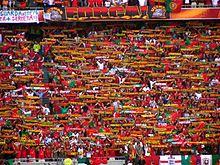
A fan or fanatic, sometimes besides termed an aficionado or partizan, is a person who exhibits strong interest OR admiration for something or somebody, such as a celebrity, a sport, a sports team, a genre, a political leader, a book, a movie, a video recording gamy or an entertainer. Collectively, the fans of a particular object OR person constitute its fanbase or fandom. They Crataegus oxycantha evince their enthusiasm in a variety of ways, so much as away promoting the object of their occupy, being members of a related rooter club, holding or involved in fan conventions or writing fan mail. They may also engage in notional activities ("rooter labor") such atomic number 3 creating fanzines, writing sports fan fiction, making memes operating theatre drawing fan art.
Etymology [blue-pencil]
Merriam-Webster, the Oxford dictionary and other sources define "winnow" as a shortened version of the Word of God fanatic. Fiend itself, introduced into English around 1550, means "marked by excessive ebullience and often intense uncritical devotion". Information technology comes from the Modern Latin fanaticus, meaning "insanely only divinely inspired". The countersign originally pertained to a temple or sacral place [Latin fanum, poetic English fane]. The red-brick sense of "extremely avid" dates from just about 1647; the use of rabid Eastern Samoa a noun dates from 1650. However, the term "fancy" for an unabated liking of something (a usage attested by 1545[1]), while beingness of a different etymology, coincidentally carries a less intense but somewhat exchangeable connotation to "fanatic". Use of "the fancy" to mean avid sports enthusiasts emerged A an Americanism in the mid-19th C.[2] The Dickson Baseball game Dictionary cites William Henry Nugent's work asserting that it was derived from the see, a term referring to the fans of a specific hobby surgery cavort from the early 18th century to the 19th, especially to the followers of packing.[3] According thereto theory, it was originally shortened to fance then just to the homonym fans.[ failing substantiation ] The Dandy American Baseball Scrapbook attributes the term to Chris Von der Ahe, owner of the Saint Louis Brown Stockings in 1882. Von der Ahe sold tickets for 25 cents, hoping the many patrons would purchase his beer; the low ticket damage helped him lead the stats attending. He called the fanatics filling his stands "fans".[4]
Supporter is a synonym to "fan" that predates the latter condition and is still commonly used in Brits English language, especially to refer fans of sports teams. Even so, the full term "fan" has get over favorite throughout the English-speaking world, including the United Kingdom. The term patron is also used in a thought sentience in the United States, to a devotee of a politician, a political party, and a controversial issue.
Characteristics [cut]
Fans usually accept a strong enough sake that few changes in their lifestyles are made to conciliate idolatry to the focal targe. Fans have a trust for external involvement – they are motivated to demonstrate their involvement with the area of interest finished in for behaviors (attending conventions, posting online, displaying team banners remote their homes, etc.). Fans often stimulate a "wish to acquire" material objects related to the area of interest, such as a baseball game hit by a famous slugger surgery a used guitar pick from their musical hero. A well, some fans have a desire for social interaction with unusual fans. This again may take many forms, from casual conversation, email, schmoose rooms, and electronic mailing lists to regular typeface-to-face meetings such as fan club meetings and organized conventions.
There are several groups of fans that can be differentiated aside the intensity layer of their level of involvement or interest in the hobby (level of fanaticism)[5] The likeliness for a subject of interest to be overhead railway to the level of fandom appears to be dictated by its complexity. Complexity allows further involvement of fans for a longer period of time because of the time needed to work the subject of interest 'out.' It also contributes to a greater sense of belonging because of the rational feat invested in the subject.[ citation needed ]
Fan culture [edit]
Types [edit]
Celebrities [edit]

These fans will oft hold a crush on a John R. Major movie star, bulge out star, athlete or celebrity (see teen idol). The groupie is an good example, a sports fan of a special banding Beaver State player, who will travel along them on concert Tours. The degree of cultism to celebrities can range from a simple crush to the deluded impression that they feature a special human relationship with the star which does not exist. In intense cases, this can lead to celebrity adoration syndrome, stalk behavior. This tail well switch to hatred of the antecedently loved celebrity, and result in attempts at furious attacks, cardinal notable incident being the death of Rebecca Schaeffer by a stalking fan in 1989.
This is somewhat related to the concept of parasocial interaction where audiences develop one-sided relationships with media characters and celebrities.
Non completely fans have a crush on their idols. There are also fans who want to suit their friends OR respect an idol's relationship. In fact, there are fans WHO idolize their celebrity couples.
Gambling [edit]
Gaming fans, or "gamers", are fans focused happening playing not-sport games, usually role-playing games, board games, miniature wargames, owed card games OR video games.
Euphony [edit]

Music fans can differ somewhat from fans of particular musicians, in that they may concentrate connected a genre of music. Many of the trade journals around euphony, much as Rolling Stone, were created by music fans. A notable music fan was groupie Artemis Plaster Caster, famous for making numerous plaster casts of rock stars' penises. Another was Pamela Des Barres, writer of the book I'm With The Band. Fans who are non groupies prefer the term supporter. In the 1960s, the extreme craze of medicine fans surrounding The Beatles became titled Beatlemania.[6] In 2022, Billboard observed that favorite musicians such Eastern Samoa Tyler, the Almighty had leveraged the power of fans to get digital downloads using merchandise bundles.[7] Similarly, GQ recognised Vampire Weekend for their commitment to extensive striation marketing for dedicated fans.[8]
Musicals [edit]
Popular musicals feature their own particular sets of fans. Snag has boasted a sizable number of 'Rentheads' since its Broadway debut.[9] [10] Similarly, fans devoted to The Phantom of the Opera have been dubbed 'Phans'.[11] In 2022, Playbill included The Phantom of the Opera house in its list of the "Best 10 Musical Fandoms" of the class.[12]
Otaku [edit]
Otaku is a Japanese term for people with obsessional interests. In Japanese Islands, the full term is usually derogatory, a connotation lacking in English people, where it loosely refers to people in the anime and manga fandom.
Politics [edit]
Masses who approve of operating room associate themselves with certain politicians operating room political groups are generally called "supporters" rather than "fans", although on that point are politicians with official Oregon unofficial "fan clubs". Intense and organized support for a politician may be referred to as a personality cult, particularly in authoritarian or totalitarian regimes.
White-collar rassling [edit]
Fans of professional wrestling can be divided into cardinal groups: marks and smarks. Derived from the homophonic term for the prey of conmen, a mark is a fan who believes that everything associated with professional wrestling is real. In contrast, a "smark" is a fan who recognizes that they are witnessing a stage-managed work ("kayfabe"), but appreciates it nonetheless, including its backstage aspects.
Science fabrication [edit]

Star Trek fans cosplaying at Atlanta Dragon Con 2010.
Since the 1920s, an more and more elaborate Cuban sandwich-culture of organized science fiction fandom has arisen, at first among correspondents to the letter columns of science fabrication magazines. This non-centralized movement has given deliver to science fiction fanzines (and amateur insistency associations), skill fiction conventions, the Hugo Awards (and various imitators/derivatives), filk music, "buff funds" such as the Trans Atlantic Winnow Fund, and a variety of other institutions, jargon and customs. It has nurtured writers and artists such as Ray Douglas Bradbury, Roger Ebert, Lenny Kaye, Michael Moorcock and Trina Jerome Robbins; and has generated much spin-offs as comic book fandom, media fandom, the Society for Creative Anachronism, gaming fandom, and furry fandom, sometimes put together referred to as "fringe fandoms".
Science fiction fandom formed its ain slang, known A fanspeak after the "Newspeak" of the novel Nineteen Fourscore-four. Fanspeak is ready-made upwards of acronyms, integrated words, obscure in-jokes, puns, coinages from science fiction novels Oregon films, and antiquated or standard English words old in specific ways relevant or amusing to the science fiction community. Some fanspeak damage, like-minded fanzine have become standard English. Some fanspeak terms relate to fans themselves:
- An Actifan is a fan engaged in "fanac" (fan activity), such as producing a fanzine or pouring a convention. The reverse is a Passifan, who enjoys the subject of the fandom and is not like a shot involved in the fandom.
- A Openhanded Name Fan (BNF) is a fan WHO has become well known within a fandom for their contributions of respective sorts, such as heading of a major blog or contributing to the franchise itself.
- Fanne was used in early fandom as a feminine same to "fan".
- Fen was misused within fandom as the plural of the word "fan", by doctrine of analogy with "men" as the dual of "man". This extended to other fanspeak terms, consequent in actifen, passifen, trufen, so Forth.
- A Trufan is a very active and dedicated fan.
Specific sub-groups of science fable fandom are often known by a assembling full term. For example:
- Trekkies are fans focused on the Maven Trek science fable franchise. Arising out of skill fabrication fandom they, to some extent, have served as a template for some other organized fandoms in the skill fable TV and film genres. Some "Trekkies" prefer to be referred to as "Trekkers" A they palpate the term "Trekkies" was used in the past as a derogatory name for them and they hope to avoid the orthodox brand sometimes associated with being legendary equally a "Trekkie". Many "archaic school" fans of the Star Trek universe rebelliously, and with pride, come to to themselves, and other Star Trek fans, as "Trekkies" rather than the kinder, gentler "Trekkers" name used by many of the newer generations of Sensation Trek fans.
- Whovians are fans of the longest lengthways science fiction television show in the world, Doc Who.
Sports [edit]

A sports buff can be an enthusiast for a particular athlete, team, sport, or all of organized sports as a whole. Sports fans often wait on sporting events in stadiums, in sports bars, or lookout man them at home on television, and follow news through newspapers, websites, and cultural media.[13]
The mental capacity of the sports rooter is often so much that they will experience a lame, or event while living vicariously through players or teams whom the devotee favors.[14] This behavior manifests itself in a number of different shipway, dependant on the venue. At a stadium Oregon arena, sports fans will voice their pleasure with a particular parenthetical, player, operating theatre team by cheering, which consists of clapping, fist-pumping, or shouting positive exclamations toward the field of play and ultimately, the affirmative object. Besides, displeasure toward a exceptional incident, participant, or team may be met by fans with booing, cheering of expletives, and sometimes throwing of objects onto the battlefield. This violent type of fan reaction is often titled hooliganism.
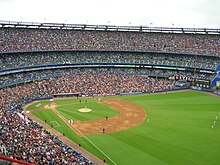
Shea Stadium filled with fans prior to the start of a Greater New York Mets game in 2008. The stadium had the best attendance in the National Conference that twelvemonth, garnering over 53,000 fans per game connected average.
Lighter, more harmless objects are likewise at times thrown onto careful fields of play as a form of jubilation of a favorable sports feat. This is most standard when a member of the home team scores a hat trick in field hockey. Other, more gentle forms of displeasure shown by sports fans at sporting events postulate simple groans of disappointment, and silence. These actions often denote that the favored home team is organism outperformed away, or has lost to the much less-favored moving squad.
In North America, extremely enthusiastic fans are often called "superfans": fans WHO dress up in outrageous and ostentatious costumes or outfits showing their devotion. Fanbases well known for their tenacious love and undying support are called rabid fans or fanatics. These fans much congregate hours before kickoff in what is known as a tailgation operating theatre tailgating.
At sports bars, sports fans will cumulate together, oft patc overwhelming food for thought and alcoholic beverages, with the purpose of following a particular sportsmanlike event on tv set as a radical. Sports bars often advertise in hopes of draft fans of a particular player or team up to watch together to increase bonds between fans and prevent fights. This can create the sense of one in a sports bar arsenic every last cheers and boos will appear to be synchronized due to similar feelings and reactions by nearly all fans at the fortunes and misfortunes of the favored team Oregon jock. Due to the level of devotion and chroma of feeling towards the favored team or athlete by sports bar patrons, as substantially as partially due to the alcohol being served, behavior that would be seen as unruly operating room fanatical outdoors a sports relegate is by and large more common inside of one. The loudness of cheering and jeering at a sports bar by sports fans can frequently range from equal to stronger than that of fans actually at the diversion event for particularly significant games and matches.
At home, sports fans may suffer few cus fans but also more freedom. This is sometimes where the most intense satisfactory Oregon jeering bequeath fall out. In the fan's own home, unbridled and lengthy screaming, crying, Acts of destruction to menag objects, and other manifestations of joy or anguish, are perhaps seen as most acceptable in comparison to the sports taproo or adventuresome venue simply because such acts taken to so much an extremum can represent seen as disruptive to a pack of fellow fans even if they parcel the same sentiment if information technology is of less intensity. The superior variables of the reaction of a sports fan in their own home are the intensity of the winnow's desire to see their team win or perform substantially, and the presence of some other: often a wife, children, or friends who may be significantly less ardent sports fans Beaver State not sports fans at all, which may significantly temper the fan's response to a highly confident Beaver State disinclined moment due to the veneration of causing a scene operating theatre scaring those close to the fan, or alienating themselves from said others. Frequently sports fans will pay for other fans of relatively similar rooting intensity over to their house to experience a sporting event in concert and so that entirely involved can voice joy or displeasure to their heart's content and increase shared bonds in the process. Information technology is becoming common for this typewrite of bonding to take place over sports-related social networks.
Fan psychology and motives [edit]
Sports [edit]

Representation of a hockey fan
The drivers that spend a penny people fans, and in finical sports fans, have been unnatural by psychologists, such as Dan Wann at Sir James Augustus Murray State University,[15] and communication scholars, such as Adam Earnheardt at Youngstown Express University.[16] [17]
They attribute people becoming fans to the following factors:[18] One chemical element is amusement, because sports spectatorship is a form of leisure. Sports is also a form of escapism, and being a winnow gives one an excuse to outcry at something, an activity that may personify constrained in other areas of one's life. Fan activities give participants a combination of euphoria and stress (about the potential for their team to lose) for which they coin the name "eustress". Fans experience euphoria during moments when act as is going well for their team, and stress when play is leaving against their team. This tension between the two emotions generates an unusual sense of pleasure or heightened sensations.[19]
Aesthetics are another delineate for around fans, who revalue the preciseness or acquirement of caper, or of the co-ordinated movement of the players during a pre-planned "play".[19] Folk bonding is a conclude for roughly fan activities. Extraordinary families watch televised sports regularly and give-up the ghost to sports games equally a family sashay to watch events and form a mental hamper with one other and as a family. Going to sports events can create a borrowed sense of self-take to be if fans identify with their teams to the extent that they think themselves to be successful when their teams have been self-made (e.g., as seen in the phrase "we have North Korean won").[19] If a winnow identifies strongly with a favorite team, they volition respond to the operation of the squad as if team success were a personal success and team up unsuccessful person a personal failure.[20]
Dedication [edit]
Lover loyalty is the loyalty felt and expressed by a fan towards the object of his/her fanaticism. Allegiances pot be strong or weak. The loyalties of sports fans suffer been deliberate by psychologists and have oftentimes been reviewed.
Fangirls and fanboys in fandoms sometimes, with different meanings, conceive their fandom to beryllium their "family," and feel very loyal to it, usually.
"Stan" fans [edit]
A stan is an excessively avid devotee and supporter of a celebrity, Television program, group, musical artist, pic or film series. The object of the stan's affection is often called "bias" (or "fave", although that is an outdated term). Supported the 2000 birdcall "Stan" by American rapper Eminem,[21] the terminus has ofttimes been used to identify artist devotees whose fanaticism matches the hardship of the obsessive character in the Sung dynasty. The word has been described as a portmanteau of "stalker" and "fan".[22] A website known every bit "Stan Wars" operating theater "stanipedia" up up to host discussions and flame wars between rival fanbases.[23] The Korean equivalent for a stan is a sasaeng. Stan cultivation has been criticized for being toxic.[24]
Usage [edit out]
Colloquially, the term can be used as both a noun or a verb.[23] Stans of a detail artist are often given more careful names, such as "Arianators" for fans of Ariana Grande[25] [26] and "Directioner" for fans of Cardinal Direction. Some artists, however, do non ingest specific titles attributed to their stans; fans of Kiley Minogue have been called Kiley Stans.[27] [28] Symmetrical for fandoms with specific titles, the "artist stan" formula still applies.[23]
Some of these monikers are just about universally known and used by fans of the artists as well as outsiders. Some other nicknames are not commonly used, neither by outsiders nor by the concerning fan-base, such as Kylie Minogue's "Kylie Stans", Madonna's "Madonna Louise Ciccone Fans", Maroon 5's "Maroon 5 Stans" or Nick Jonas's and so named "Nick Jonas Fans", usually appearing on social media networks such as Twitter and Tumblr,[23] The term "stan" is also wont to describe fans of K-pop.[ citation needed ] The terminus is not to be confused with Sasaeng fans, which are overly obsessed fans WHO stalk and sometimes bring injury to idols.[ Citation needed ]
The term was added to the Oxford English Dictionary in 2022.[29] [30] [31]
Celebrity reaction [redact]
Celebrities have positively reacted to their "stan" followings. Notably, English singer-songwriter Jessie J had this to say about her stans, "They confirm me and buy up my albums and singles, and they stand outside hotels, and they come to shows, and they get tattoos of my lyrics and they cut their hairsbreadth like me. You have to love your fans. That's wherefore I call them my Heartbeats, because without them I wouldn't be Here".[32] In 2012, after Jessie J broke her own leg, a stan broke her own leg to emulate the injury. The fan tracked Down Jessie J's physical turn to and sent her a photograph of the individual-inflicted injury. The singer was horror-struck and decided to addition her security.[33]
Singer-songster Lorde has a different opinion on the matter of giving her followers a nickname. She discouraged information technology by saying "I find it cacophonous to lump everyone into a really awkward, punning-centric name" and affirmed she will never name her fanbase.[34]
Gender stereotypes [edit]
Societal gender roles [edit]
Discrimination against females [edit]
Women tend to be "more restricted in their leisure choices and opportunities than work force,"[35] and their experiences within fandoms are typically demeaned to a more sexualized, emotional, operating theatre bodily experience, as conflicting to intellectual interests.[36] [37] [38] For instance, in euphony, women are more preponderating, and accepted, within pop music fandoms, which Diane Railton describes as evoking an emotional and physical response, in counterpoint with the 'masculine' careen music, which is defined as 'sedate' music with a 'significance', focusing on governmental, cultural, and psychological give-and-take.[37] Collectable to this, women are rarely given space or voice within the mental region of music.[37] According to Frank Zappa, "men get along to hear the music and chicks come for the sex thrills,"[39] implying that women's participation in fan communities is purely sexual, and that they are incapable of displaying intellectual surgery artistic interestingness in the medicine itself.[37] Those who do manage to become involved within the world of 'serious' music are often relegated to the realm of a 'groupie'.[36] A groupie, according to Cheryl Cline, is
[A] person (a woman, usually), who 'chases after' sway stars, American Samoa my bring fort would say. Simply 'groupie' is also utilized more or less synonymously with 'girl Rock'n'roll fan', 'female diarist', and 'woman Tilt musician'; information technology's used to mean anyone working in the medicine field World Health Organization isn't actually a Rock candy musician; it's used A an all-purpose insult and a slut on one's professionalism; information technology's used as a cute term for 'hero worship'; and it's used interchangeably with 'fan'.[36]
In separate quarrel, the term 'groupie' (used synonymously with the term 'devotee' or 'fangirl') is frequently utilized to shame women knotty within the euphony community, restricting their involvement to sexual relations with band members OR worshipping male rock stars.[36]
This trend can also represent observed inside other winnow communities, such as comic book fandoms, where women are often portrayed as "Fake Eccentric Girls", only interested in comic books to print guys or to view the attractive men present inside their content,[40] [41] operating theater sports communities, where women are much made uncomfortable at hold up sporting events due to the overt sexism and aggressive maleness displayed by phallic spectators, and so labelled as 'inauthentic' for viewing the games via television set or else.[35] Within ice hockey, female fans are frequently called "Puck Bunnies", defined as,
[S]omeone WHO hangs around the players, always on the lookout man for the chance to arrive that John Hancock / photograph / quick pint [drink] / quick human knee trem-bler round the back of the Arena from the player OR players (or equal coach) of their choice, heck let's look information technology tied the water carrier is in with a chance here.[38]
Such discrimination against female fans butt become vehement at times in an elbow grease to police "genuineness".[42] The modern events familiar as GamerGate provide a good example of such attacks, whereby multiple women working inside the gaming industry were victims of sexual harassment and raging threats, approximately even unscheduled to leave their homes for fear of a physical encounter.[43] [44] [45]
The fangirls', often stereotypic as female, so-called 'delirium' is described as the mathematical product of physiological property repression.[46] Nonetheless, while it is expected for women to be implicated in reliable fandoms for physical or sexual reasons, this is also viewed as undesirable and goaded by hormonal changes.
These Acts of the Apostles of adoration are societally limited to adolescent youth, Beaver State menopausal women, in both instances blaming "these cardinal periods of secretion indulgence" on the incoherent, overtly physiological property conduct.[36] For example, Cheryl Cline, in her text entitled "Essays from Bitch: The Women's Rock Newsletter with Bit", discusses how women necessitate to keep down their interests out of sight once they reach adolescence.[36] In her ain words, "[i]t's a sign of maturity to pack up all the posters, photos, magazines, scrapbooks, and wildcat biographies you so lovingly collected and stuff them in the back of the cupboard.[36]
These opposed accounts of fangirl behaviour are owed to the belief that women are not supposed to express so much intimate fantasies unless influenced past some hormonal induced flakiness, while for men IT is pattern to be sexual regardless of age.[36] As Cheryl Cline summarizes,
It's much easier for a human beings to equal indulgent about the crushes of teenage girls than it is for him to be in-bounds-minded about the sexual fantasies of the woman he loves when they're around someone else. And the same bozo who'll leave Penthouse in the toilet will yell, 'None woman of mine is gonna give ear a bill of Prince naked to the shank on the at bottom of the closet of the lean elbow room where no one will realise it!' […] [U]ntil you reach the age when everybody thinks you'Ra crazy anyway, so wherefore not admit to an extreme yen to run your fingers finished Willie Nelson's whiskers?[36]
Favoritism against males [edit]
Reported to Jackson Katz in the documentary film Gristly Guise 2, boys are taught early on it to be "real men" they need to be toughened and non to show their feelings.[47]
[Men] can't show some emotion demur anger. We tush't call up too much or look too intellectual. We can't back down when someone disrespects USA. We have to show we'atomic number 75 tough enough to visit physical pain and take it in turn. We're supposed to be sexually aggressive with women. And then we're taught that if we step out of this box, we risk being seen as soft, weak, feminine, or gay.[47]
He later elaborates, stating that,
Qualities the like compassionateness, caring, empathy, intellectual curiosity, fear, vulnerability, even love – basic human qualities that boys feature inside them every bit as much as girls do – get methodically driven retired of them by a prejudiced and prejudiced culture that labels these things as 'unmanly,' 'feminine,' 'womanly,' and 'gay,' and teaches boys to nullify them at all costs. And, most importantly, they're taught that real manpower turn to violence not equally a last resort, but equally the go-to method of resolving disputes – and also as a primary means of winning respect and establishing masculine credibility.[47]
In the predecessor to this documentary, Tough Guise, Katz also addresses the issue of body see, victimization multiple movies, such equally Terminator and Rambo, as well as action figures like G.I. Joe, to illustrate how 'real men' are formed Eastern Samoa big, strong, and muscular.[48]
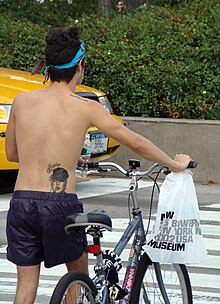
A man with a tattooo of Madonna on his back off pushing a bicycle with a "Madonna" dagger. On his articulatio humeri is a tattoo of the words "possibly maybe", which is the title of a song by Björk.
Fanboy portrayals, by definition, do not fit into this mold of a 'real man', with the elision of sports fans. In a study by Gerard Jones on laughable book fans, he described the funny book fanboys as "small, unquiet, withdrawn, and panicked of the opposite sex activity."[49] Quite the opposite of the 'real man' previously described past Katz. Their interests may also be well-advised as a divagation from societal gender roles, according to Noah Berlastsky, such as playing Dungeons and Dragons instead of football.[50] This lack of traditional masculine traits warrants them much annoying from peers, paternal figures, coaches, surgery older male role models for not conforming to these ideas of masculinity.[47] [50] [51] A popular example of such handling in mainstream media is shown on the sitcom The Big-bang theory, where, multiple multiplication throughout the show's run, the four main characters, portrayed as 'nerdy fanboys', are humiliated by larger 'real men'. E.g., in the show up pilot program, the two primary characters, Leonard and Sheldon, get their drawers taken by the of import pistillate character's ex-boyfriend, who is portrayed as ample, invulnerable, sinewy, positive, and successful with women.[52]
Furthermore, fanboys likewise deal with issues of gender secernment in relation to their fandom interests. For example, Bronies, a group of teenage men enthralled by the TV show My Little Pony: Friendship Is Magic, a testify typically geared towards young girls, are often the quarry of make fun. Their interest in a 'distaff' media item can be the cause of slap-up shame, causing many to become 'nonpublic' bronies, enjoying the show in secret out of fear.[53]
Fangirl [edit]
| | This incision needs expansion with: nonpartisan stand. You can assistanc past adding thereto. (July 2022) |
![[icon]](https://upload.wikimedia.org/wikipedia/commons/thumb/1/1c/Wiki_letter_w_cropped.svg/44px-Wiki_letter_w_cropped.svg.png)
Fangirls are often depicted as teenagers obsessed with something to a frightening degree. The term is ofttimes ill-used in a demeaning, derogatory fashion and is aforesaid to describe the fans that give "normal" fans a bad mention. In fact, the term "fangirling" is misused to name anyone who obsessively follows a certain fandom pertinent where it interferes with their daily lives. Such a trend of 'authentic' versus 'inauthentic' buff is common within fan communities, and is in particular appropriate to grammatical gender discrimination and misogynistic ideals.[42] However, on the other hand of the spectrum, some fangirls throw embraced the form of address, considering it a compliment rather than a derogatory term.
Immaturity in fangirls [edit]
| | This surgical incision of necessity expansion with: unbiased viewpoint. You can help by adding to it. (July 2022) |
In terms of their involvement within fandoms, fangirls are typically portrayed as losing all control, fainting, sobbing, and spirited about in mobs.[46] For instance, patc describing the phenomenon of Beatlemania, fan activity is described by stating that:
The appropriate chemical reaction to contact with [the Beatles] – much as occupying the same auditorium or urban center block – was to sob uncontrollably spell uproarious, 'I'm gonna die, I'm gonna dice,' or, more optimistically, the name of a favorite Beatle, until the onset of either unconsciousness or laryngitis. Girls peed in their pants, fainted, or simply collapsed from the hot-blooded strain.[46]
Furthermore, while discussing Beatlemania and the crazed Beatles fangirl behaviour, Barbara Ehrenreich, Elizabeth Heiss, and Gloria Jacobs mention how the 'only cure' for what was at the fourth dimension considered an affliction was senesce, and that likewise to "the girls who had screamed for Frank Sinatra," the Beatles fangirls would "[grow] adequate be responsible, settled "[46] individuals.
Fanboy [redact]
| | This department needs expansion with: fair point of view. You can help past adding to it. (July 2022) |


Fanboys are frequently portrayed as "wrothful nerds", over-aggressive, derogatory, and protective of the object of their obsession,[54] or as bespectacled, geekoid, obsessive fans. The terminus nerd, defined as "[an] insignificant, foolish, or socially tactless person; a person WHO is boringly conventional or studious; a person World Health Organization pursues an unfashionable or highly technical interest with obsessive or unshared dedication,"[55] as well as the terminal figure geek, defined as "[a] person […] who is regarded atomic number 3 foolish, offensive, worthless; an overly persevering, unsociable student; whatsoever unsociable mortal obsessively devoted to a item sideline,"[56] are ofttimes used to describe stereotypical fanboys. In regards to elect fandoms, they are typically associated with comic books, video games, science fiction movies or television series, or technology (such as computer or smartphone brands).[54]
An exception to this portrayal is the sports fan, who is expected to be overtly sexual, and aggressive.[35] This portrayal is particularly dominant within the field house, which provides a legitimate site for people to act in hyper masculinized ways.[35] According to Sir Bernanrd Williams, "Many [hands] wishing to constitute overtly sexist and racist. They need to have this exaggerated sensory faculty of their sexuality to oppose themselves from potential accusations that they are not real men."[57]
Immaturity in fanboys [edit]
Fanboys are often depicted arsenic quite angry, violent, and offensive while defending the objects of their heart, such arsenic the smartphone fanboys who frequently verbally attack anybody saying anything the slightest bit offensive about their chosen technological product through online anonymous sites.[54] In fact, the condition 'fanboy' is often used as an affront towards other fans, deemed senseless, self-important, or overly loyal to their chosen token of warmheartedness.[ citation needed ]
Such defensiveness is especially prominent against women who are interested in their chosen fandoms or who vex a "threat" to their residential area. For example, in 2012, male gamers created a Flash game in which players could physically assault Anita Sarkeesian, a woman who launched a Kickstarter to create a series of documentaries on women tropes in video games.[42]
These violent Acts against Sarkeesian continued in 2014, during the disputable event surgery movement known as GamerGate, during which Sarkeesian accepted many threats by fanboys owing to her Tropes vs Women series on YouTube, where she analyzes the so-called limited and sexist female roles open in video games. These threats escalated dangerously, requiring her to leave her home in fear for her safety, as symptomless every bit cancel a speaking engagement at Beehive State State University after there were threats of a mass shooting on campus collectable to her presence.[43] Such unfavourable acts of violence towards women are not isolated cases. For instance, male risible volume fans frequently harass women frequenting comic book shops, either by humbling them or by hitting on them, causing them to feel uncomfortable and excluded from the fan residential area.[42]
Get wind also [edit]
- Rooter activism
- Fan art
- Fan nightspot
- Fansite
- Sports fan studies
References [edit]
- ^ ""fancy, v." OED Online". Oxford University Press. July 2022. Retrieved October 16, 2022.
- ^ "The Vocabularist: Are fans fanatical or fanciful? - BBC News". Bbc.co.uk. September 22, 2022. Retrieved September 3, 2022.
- ^ Stephen A. Douglas Harper. "Fan (n.2)". Online Etymology Dictionary . Retrieved May 22, 2012.
- ^ Suehsdorf (1978). The Great Solid ground Baseball Scrapbook. Random House. ISBN0-394-50253-1.
- ^ Thorne, Scott; Bruner, Gordon C. (2006). "An exploratory investigation of the characteristics of consumer zealotry". Qualitative Securities industry Research. 9 (1): 51–72. doi:10.1108/13522750610640558.
- ^ Taylor, Alan. "1964: Beatlemania - The Atlantic". www.theatlantic.com . Retrieved October 18, 2022.
- ^ "Merch Bundles, Memes & Thomas More: Mondo.NYC Conference Discusses What's Influencing Music Charts". Hoarding . Retrieved October 18, 2022.
- ^ "The Very Intense Merch Galaxy of Lamia Weekend". GQ . Retrieved October 18, 2022.
- ^ Paulson, Michael (January 21, 2022). "A Multitude of Fans, With a High Regard for Great White Way". The New York State Times. ISSN 0362-4331. Retrieved October 18, 2022.
- ^ "The Funniest Reactions to the Not-So-Live 'Rent' Inhabit Show". Vogue . Retrieved October 18, 2022.
- ^ "'RoseBlood' source A.G. Howard negotiation 'Phantom,' lore, and Thomas More". Hypable. January 12, 2022. Retrieved October 18, 2022.
- ^ Fitzpatrick, Genus Felicia (November 29, 2022). "The Top 10 Chanted Fandoms of 2022 on Tumblr". Playbill . Retrieved October 18, 2022.
- ^ Earnheardt, Adam C.; Haridakis, Paul M. (May 30, 2013). "Understanding Fans' Consumption and Dissemination of Sports: An Introduction". In Earnheardt, Go C.; Haridakis, Paul M.; Hugenberg, Barbara (eds.). Sports Fans, Identity, and Socialization: Exploring the Fandemonium. Lexington Books. pp. 1–6. ISBN978-0739146217.
- ^ Earnheardt, Adam C.; Haridakis, Paul M. (October 1, 2009). "An examination of devotee-athlete interaction: Fandom, parasocial interaction, and designation". Ohio Communication Journal. 47: 27–53.
- ^ Wann, Book of Daniel L. (January 10, 2001). Sport Fans: The Psychological science and Social Impact of Spectators. Routledge. ISBN978-0415924641.
- ^ Earnheardt, Adam C. (June 28, 2012). Judging Jock Behaviors: Exploring Possible Predictors of Television Viewer Judgments of Jock Antisocial Behaviors. AV Akademikerverlag. ISBN978-3639433456.
- ^ Earnheardt, Adam C.; Haridakis, Paul M.; Hugenberg, Barbara, explosive detection system. (May 30, 2013). Sports Fans, Identity, and Socialization: Exploring the Fandemonium. Lexington Books. ISBN978-0739146217.
- ^ Mark Conrad (2006). "What Makes Sports a Unique Business?". The Business of Sports: A Primer for Journalists. Routledge. xxx–xxxi. ISBN0-8058-5044-9.
- ^ a b c Earnheardt, Adam C.; Haridakis, Paul M. (July 16, 2008). "Exploring Motives and Fandom for Viewing Televised Sports". In Hugenberg, Saint Lawrence W.; Haridakis, Paul M.; Earnheardt, Adam C. (EDS.). Sports Mania: Essays connected Fandom and the Media in the 21st C. MacFarland. pp. 158–171. ISBN978-0786437269.
- ^ Lynn R. Kahle; Angeline G. Close (2011). Consumer Behavior Knowledge for Good Sports and Issue Merchandising. New York City: Routledge. ISBN978-0-415-87358-1.
- ^ Georgia Okeeffe, Kevin (August 25, 2014). "Directioners, Arianators, Mixers, the Skeleton Pack, Katy Cats, Ohio My: Stanbase Names, Ranked". The Atlantic Ocean . Retrieved December 19, 2014.
- ^ Foley, Maddy. "What Does "Stan" Mean? Everything You Need to Know About the Slang". Hustle . Retrieved September 20, 2022.
- ^ a b c d Hawgood, Alex (October 5, 2011). "Scratching the Celebrity Itch". The New York Times . Retrieved September 11, 2012.
- ^ "In 2022, Let's Have A Less Virulent 'Stan' Civilization". HuffPost Canada. January 2, 2022. Retrieved June 11, 2022.
- ^ Sullivan, Caroline (May 24, 2022). "Arianators assemble: Ariana Grande's fans weave a web of support". The Guardian. ISSN 0261-3077. Retrieved June 12, 2022.
- ^ Leaver, Kate (May 25, 2022). "Ariana Grande fans are grief-stricken jointly and their persuasiveness is beautiful". Metro . Retrieved June 12, 2022.
- ^ Martin, Samantha (August 21, 2012). "Daily Tweetcap: Lady Gaga Stans For Kylie Minogue". Pop Dust . Retrieved September 11, 2012.
- ^ Anitai, Tamar. "12 Unforgettable Moments In VMA History: Live Snakes, Baby Bumps, Meat Dresses, OH My!". MTV Buzzworthy. Viacom. Retrieved September 11, 2012.
- ^ "Stan | Meaning of Stan by Lexico". Lexico Dictionaries | English . Retrieved February 7, 2022.
- ^ Lang, Cady (June 1, 2022). "'Stan' Is Instantly in the Oxford English Dictionary". Time . Retrieved February 7, 2022.
- ^ "Stan, an Eminem song from 2000, is now in the Oxford English Dictionary". BBC News. BBC. June 2, 2022. Retrieved June 2, 2022.
- ^ Anitai, Tamar. "Jessie J Dialogue 'Fats Domino,' Dedicates Her VMA Operation To The Heartbeats". MTV News. Viacom. Archived from the original on July 5, 2012. Retrieved Sep 11, 2012.
- ^ Sciarretto, Amy. "Jessie J Increases Security After Fan Breaks Leg to Be Like Her". Pop Crush . Retrieved September 11, 2012.
- ^ "Lorde Doesn't Want a Artful Name for Her Fans".
- ^ a b c d Gosling, Victoria K. "Girls Allowed? The Marginalization of Egg-producing Sports Fans." EDS. Gray, Jonathan, et al. Fandom: Identities and Communities in a Mediated Existence. New House of York: New York University Press, 2007. Print. 250-260.
- ^ a b c d e f g h i Cline, Cheryl. "Essays from Bitch: The Women's Rock and roll Newsletter with Bite." Ed. Lewis, Lisa A. The Fond Interview: Fan Culture and Popular Media. New York; British capital: Routledge, 1992. Print. 69-83.
- ^ a b c d Railton, Diane. "The Gendered Carnival of Pop." Nonclassical Music: Grammatical gender and Sex. 20, 3. (Oct. 2001): 321-331. JStor. Web. 26 Oct. 2014.
- ^ a b Crawford, G. and Gosling, V.K. "The Myth of the Puck Bunny rabbit: Distaff Fans and Work force's Icing Hockey." Sociology: 38 (3), 2004. 477-493.
- ^ Hiwatt, S. "Cock rock." Twenty-Careful Fandangos and Forever Changes: A Rock Bazaar. Ed. J. Eisen. New York State: 1971. 141-7.
- ^ "If Geek Girls Acted Like Geek Guys". YouTube. August 25, 2014. Archived from the original on Dec 11, 2022. Retrieved September 3, 2022.
- ^ Gavia Bread maker-Whitelaw (August 27, 2014). "The absurdity of this 'fake flake guys' video makes a powerful point". The Daily Dot . Retrieved September 3, 2022.
- ^ a b c d "Fangirls in refrigerators: The politics of (in)profile in comic book culture | Scott | Transformative Works and Cultures". Journal.transformativeworks.org. Retrieved September 3, 2022.
- ^ a b Collins, Sean T. (October 17, 2014). "Anita Sarkeesian along GamerGate: 'We're Sledding to Fix This'". Resonating Stone . Retrieved Sept 3, 2022.
- ^ "Zoe Quinn: GamerGate mustiness cost condemned - BBC News". Bbc.com. October 29, 2014. Retrieved September 3, 2022.
- ^ Peter Frase (October 4, 2014). "In Defense of Gamers". Jacobin. Retrieved September 3, 2022.
- ^ a b c d Ehrenreich, Barbara, Elizabeth II Hess, and Gloria Jacobs. "Beatlemania: Girls Good Neediness to Have Fun." Ed. Lewis, Lisa A. The Adoring Hearing: Fan Culture and Popular Media. Unaccustomed York; London: Routledge, 1992. Black and white. 84-106.
- ^ a b c d Tough Guise 2. Writ./Dir. Jackson Katz and Jeremy Earp. Media Education Foundation Production, 2013.
- ^ Pugnacious Guise. Writ. Thomas J. Jackson Katz. Dir. Sut Jhally. Media Education Foundation Production, 1999.
- ^ Jones, Gerard. Workforce of Tomorrow: Geeks, Gangsters, and the Parentage of the Comic Book. New House of York: Alkalic Books, 2004.
- ^ a b "Why Geeks Get Bullied (It's Not Necessarily for Beingness Geeks)". The Ocean. January 31, 2013. Retrieved September 3, 2022.
- ^ Pustz, Matthew. Comic Book Culture: Fanboys and Apodeictic Believers. Helen Hunt Jackson: University Press of MS, 1999.
- ^ "Pilot." The Big Bang Theory. Writ. Chuck Lorre and Bill Prady. Dir. James Burrows. Retch Lorre Productions. Warner Bros. Television, CA, USA. 24 Family. 2007.
- ^ "BABScon 2014 - Bronies; An Psychoanalysis of Fandom and Gender". YouTube. April 26, 2014. Archived from the original on December 11, 2022. Retrieved September 3, 2022.
- ^ a b c "Fanboys". The Brink. January 24, 2014. Retrieved September 3, 2022.
- ^ "swot, n." OED Online. Oxford University Press, September 2014.
- ^ "geek, n." OED Online. Oxford University Crusade, Sep 2014.
- ^ Coddington, A. One of the Lads: Women who Keep an eye on Football. London: Harper Collins, 1997. Photographic print.
- Daniel L. Wann; Merrill J. Melnick; Gordon W. Russell; Dale G. Pease (2001). SportFans: The Psychology and Social Wallop of Spectators. London: Routledge. ISBN0-415-92463-4.
- Tucker, Bob. The Neo-Fan's Guide on To Science Fabrication Fandom. 8th Edition, 1996. KaCSFFS Press. No ISBN listed.
- Fuschillo, Gregorio (2020). Fans, fandoms, or fanaticism?. Diary of Consumer Culture, 20(3), 347-365.
External links [edit]
 | Look up stan in Wiktionary, the free lexicon. |
- Merriam-Webster: fan
- Oxford University Dictionary: fan
- Notes connected fandom
Which Nba Team Has the Biggest Fan Base
Source: https://en.wikipedia.org/wiki/Fan_(person)


0 Comments